KNOWHOW to play: turn a mission into a skill
Design a small learning mission with visible evidence, a fair stopping point, and a useful result.
Choose something worth making
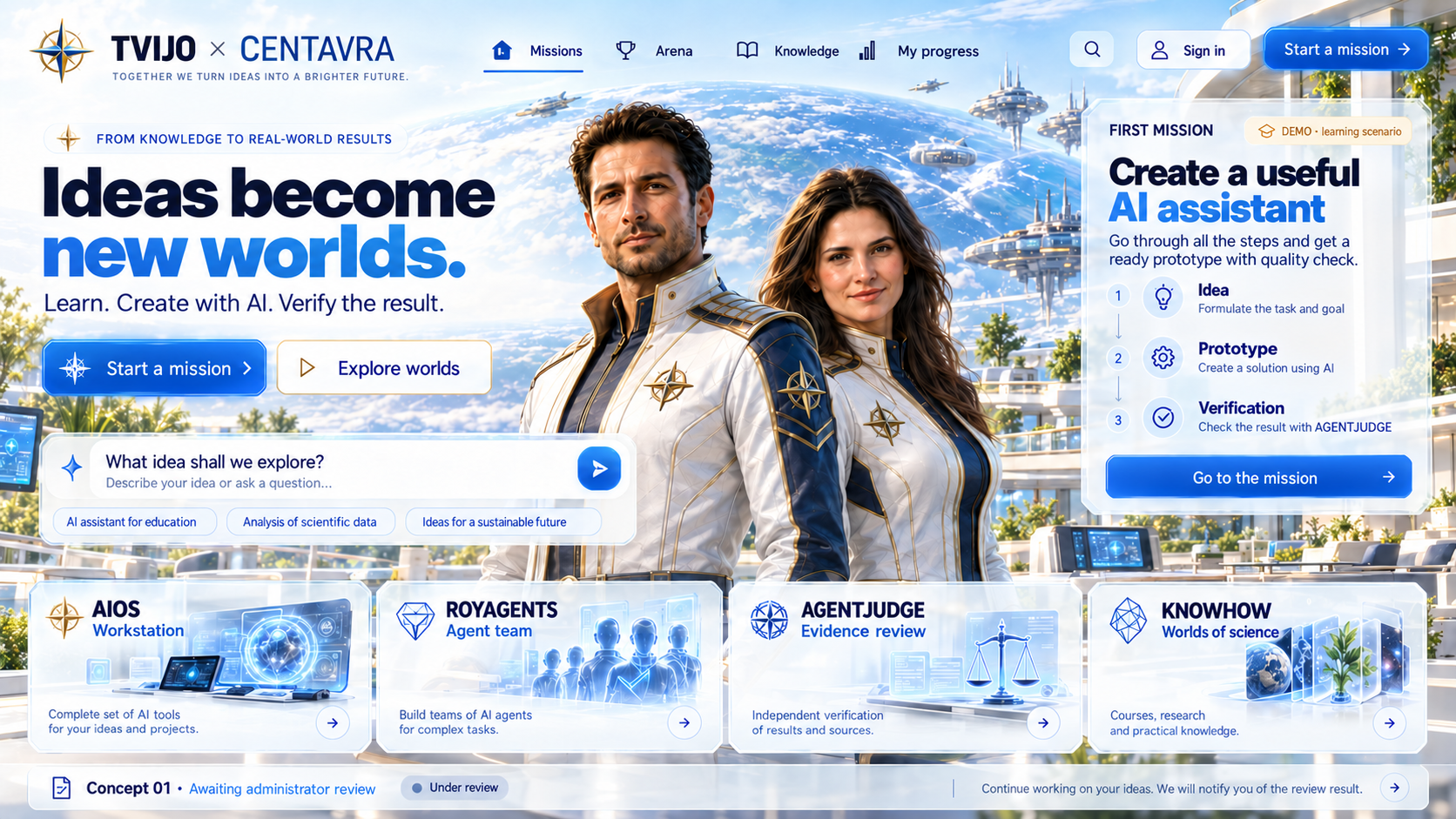
Imagine Admiral Senta opening a mission card while Julia Senta asks what the crew will learn. In this proposed universe, TVIJO work and education at tvijo.com connect with the Centavra Play sandbox at centavracoin.xyz. A cold white and blue cosmic family gives the setting continuity; the learner supplies the investigation. The robot, drone, and children can model questions and mistakes. These are concept guides, not announcements of launched games. Start with one useful outcome: explain a route, compare designs, or document a repair.
Make progress inspectable
KNOWHOW uses ALKNDA evidence: attach the supplied source, its date, the relevant observation, and the limit of the claim. A drawing can show a design idea; it cannot prove that a device works. Save a first attempt beside a revision, then explain the difference. Reward the resulting skill, portfolio piece, or discovery. Avoid cash or token promises, gambling, paid random rewards, and coercive streaks. A learner should be able to pause without losing earned work or being shamed by the story.
Offer reasons to return
Octalysis offers eight design lenses: purpose, accomplishment, creativity, ownership, social connection, scarcity, curiosity, and loss. We propose using purpose for a crew problem, creativity for alternative solutions, and ownership for an exportable notebook. Scarcity can become an optional material constraint; loss must never threaten a child's belonging. This is a proposed adaptation, not evidence of educational efficacy. The primary framework is at https://yukaichou.com/gamification-examples/octalysis-gamification-framework/. Ask whether each mechanic helps the learning task before adding it.
Pick support before difficulty
Suggested paths are ages 7–11 with an adult, 12–15 guided, 16–17 through a project, and 18+ independently. These are design suggestions, not tested safety classifications. Offer text, spoken explanation, and a static diagram where practical; permit an offline equivalent. The same mission can ask a younger learner to identify evidence and an older learner to challenge it. The actual next action is to write one mission card containing a goal, an artifact, an evidence requirement, and a voluntary stopping point.
Try it yourself
Rewrite this proposed mission: return every day to become the best pilot. Use the task of drawing a route between two fictional stations. Acceptance: the revised card names a route drawing, explains one route choice, requests evidence, and allows stopping after one attempt.
Check your result
- An acceptable answer is: draw two routes, choose one, cite the supplied map, and save your reason.
- The reward is the explained drawing; there is no compulsory return.
- The evidence supports a route choice, not a claim about real spacecraft.
This draft stays on your device until you download it. Use the TVIJO discussion for server-stored feedback.